
TEAS® Math Study Guide
Basic Math and Operations
Rational and Irrational Numbers
Rational numbers are numbers that can be written as a fraction of two integers.
Examples:
Whole numbers: \(0,5,100\)
Fractions: \(\dfrac{1}{3}, -3\dfrac{2}{5}\)
Decimals that terminate or repeat: 0.75, -1.333…
Tip: Rational numbers can be both positive and negative.
Irrational numbers cannot be written as simple fractions. Their decimals go on forever without repeating.
Examples:
\(\pi = 3.14159…\)\(\sqrt{2} = 1.4142..\)
Fractions
Fractions represent parts of a whole. They are expressed as one integer over another with a dividing line between them.
In the fraction \(\dfrac{a}{b}, a\) is called the numerator and represents the part; \(b\) is called the denominator and represents the whole.
Tip: The denominator of a fraction cannot be zero.
Types of fractions:
There are three types of fractions: proper fractions, improper fractions, and mixed fractions.
In proper fractions, the numerator is less than the denominator.
Examples: \(\dfrac{3}{4}, \dfrac{1}{2}\)
In improper fractions, the numerator is greater than or equal to the denominator.
Examples: \(\dfrac{7}{2}, \dfrac{11}{9}\)
Mixed numbers consist of a whole number and a proper fraction together.
Examples: \(1 \dfrac{3}{10}, −7 \dfrac{2}{3}\)
Tip: Fractions can be positive or negative.
An improper fraction can be converted to a mixed number (i.e., a whole number plus a fraction) by dividing the numerator and denominator and finding out the quotient and the remainder.
Example:

Put another way: \(\dfrac{11}{9} → 11 ÷ 9 = 1 \ \text{remainder} \ 2\).
Thus, \(\dfrac{11}{9} = 1 \dfrac{2}{9}\).
Conversely, a mixed number can be converted and expressed as an improper fraction by multiplying the whole number by the denominator and adding the numerator to it to find the new numerator.
Example:
\( 1 \dfrac{3}{10} → \dfrac{(10 \times 1)+3}{10} = \dfrac{13}{10}\)
Tip: A fraction can be simplified or reduced by dividing both the numerator and the denominator by their greatest common divisor or factor.
Operations with Fractions
Just like with whole numbers, all four operations (addition, subtraction, multiplication, and division) can be performed with fractions.
Addition and Subtraction
Step 1: Find a common denominator.
Step 2: Adjust numerators accordingly.
Step 3: Add or subtract the numerators.
Step 4: Simplify if needed.
Example:
Solve:
\(\dfrac{2}{3} – \dfrac{1}{6}\)
Step 1: Multiply the numerator and denominator by the same number to reach a common denominator.
\(\dfrac{2 \times 2}{3 \times 2} – \dfrac{1 \times 1}{6 \times 1}\)
Step 2: Adjust fractions accordingly.
\(\dfrac{4}{6} – \dfrac{1}{6}\)
Step 3: Subtract.
\(\dfrac{4}{6} – \dfrac{1}{6} = \dfrac{3}{6}\)
Step 4: Divide the numerator and denominator by the same number to simplify.
\(\dfrac{3 ÷ 3}{6 ÷ 3} = \dfrac{1}{2}\)
Multiplication
Step 1: Multiply the numerators together and the denominators together.
Step 2: Simplify the resulting fraction.
Example:
Solve:
\(\dfrac{2}{3} \times \dfrac{1}{6}\)
Step 1: Multiply across the fractions.
\(\dfrac{2 \times 1}{3 \times 6} = \dfrac{2}{18}\)
Step 2: Simplify.
\(\dfrac{2}{18} = \dfrac{1}{9}\)
Division
Step 1: Flip the second fraction (also called “taking the reciprocal”).
Step 2: Change the division operation to multiplication.
Step 3: Multiply.
Step 4: Simplify.
Example:
Solve:
\(\dfrac{2}{3} ÷ \dfrac{1}{6}\)
Step 1: Take the reciprocal.
\(\dfrac{2}{3} ÷ \dfrac{6}{1}\)
Step 2: Change the division sign to multiplication.
\(\dfrac{2}{3} \times \dfrac{6}{1}\)
Step 3: Multiply.
\(\dfrac{2}{3} \times \dfrac{6}{1} = \dfrac{12}{3}\)
Step 4: Simplify.
\(\dfrac{12}{3} = \dfrac{4}{1} = 4\)
Tip: The reciprocal of a fraction can be obtained by flipping its numerator and denominator.
Decimals
Just like whole numbers have place values (e.g., ones, tens, hundreds), decimals also have place values—but to the right of the decimal point.
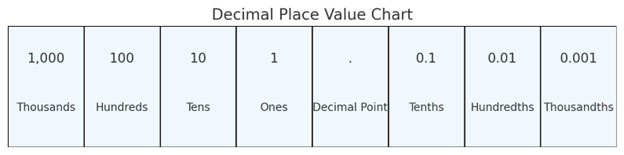
Example:

Tip: Tenths, hundredths, thousandths … each place is 10× smaller than the one before.
Rounding
To round decimals, look at the digit after the place you’re rounding to:
- If it’s 5 or more → round up (by adding 1)
- If it’s less than 5 → round down (by keeping it the same)
Example:
Round 3.786 to the nearest hundredth.
You are rounding to the hundredths place, so you should look at the thousandths place. Its value is 6, which is greater than 5. Thus, you should round up the hundredths place (8) by adding one and making it 9.
\(3.786 → 3.79\)
Decimal Operations
Addition and Subtraction
Step 1: Line up decimal points vertically.
Step 2: Add zeros if necessary to equalize place values.
Step 3: Perform the operation as you would with whole numbers.
Example:
Step 1: Line up decimal points.
Step 2: Add zeroes to equalize place values.
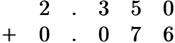
Step 3: Perform the operation.
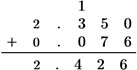
Tip: Always align decimal points when adding or subtracting.
Multiplication
Step 1: Ignore the decimals and multiply as whole numbers.
Step 2: Count the total places to the right of the decimal in both factors.
Step 3: Move the decimal that many places to the left when writing your answer.
Example:
\(0.3 \times 0.06\)
Step 1: Multiply without decimal places.
\(3 \times 6 = 18\)
Step 2: Count the total places to the right of the decimal in both factors.
There are three decimal places in both factors together.
Step 3: Move the decimal that many places to the left when writing your answer.
18 becomes 0.018.
Division
Step 1: Make the divisor (the dividing number) a whole number by moving the decimal to the right.
Step 2: Move the decimal in the dividend (the number being divided) the same number of places.
Step 3: Divide as with whole numbers, then place the decimal in the answer in the same place as the dividend.
Example: \(1.26 ÷ 0.3\)
The divisor (0.3) can be made a whole number by moving the decimal point one place to the right. Do the same for the dividend (1.26).
\(1.26 ÷ 0.3\) becomes \(12.6 ÷ 3.\)
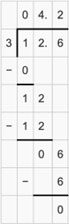
Tip: Convert the divisor to a whole number first, and then move the decimal in the dividend by the same number of places.
Converting Fractions and Decimals
Fractions and decimals are both ways to represent parts of a whole. Some problems involve converting between fractions and decimals.
The place values in a decimal tell you what the denominator of your fraction will be. The decimal .38, for example, goes to the hundredths, so in fraction form, it is \(\dfrac{38}{100}\). However, this is not simplified; both the numerator and the denominator can be divided by 2, so the most simplified version is \(\dfrac{19}{50}\).
Example:
Convert .15 to a fraction.
\(0.15 = \dfrac{15}{100}\)\(\dfrac{15}{100} = \dfrac{3}{20}\)
You can also convert fractions into decimals. Fractions with denominators with a base of 10 (10, 100, 1000 etc.) are the easiest, because they tell you exactly what numbers to put in what place values.
Example:
Convert \(\dfrac{125}{1000}\) to a decimal.
\(\dfrac{125}{1000} = .125\)Other fractions are more complicated. Remember that the line between the numerator and denominator is a dividing line; to convert a fraction into a decimal, you can divide the numerator by the denominator.
Example:
Convert \(\dfrac{7}{8}\) to a decimal.
\(\dfrac{7}{8} = .875\)
Converting fractions or mixed numbers to decimals can help you compare values quickly and easily. It is easier to tell that .875 is greater than .800 than it is to tell that \(\dfrac{7}{8}\) is greater than \(\dfrac{12}{15}\).
Tip: Knowing a few standard fractions and decimals can help save you time. For example,\(\dfrac{1}{4}\) is one quarter of a whole, equal to 0.25 and \(\dfrac{25}{100}\).
Order of operations
For complex operations involving whole numbers, integers, fractions, and decimals, follow PEMDAS to decide the order of operations:
| Step | Letter | Operation | Symbol | Rule |
| 1 | P | Parentheses | \(()\) | Do what’s inside the parentheses first |
| 2 | E | Exponents | \(a^2\) | Solve powers or square roots |
| 3 | M | Multiplication | \(\times\) | Solve left to right (same priority as D) |
| 3 | D | Division | \(÷\) | Solve left to right (same priority as M) |
| 4 | A | Addition | \(+\) | Solve left to right (same priority as S) |
| 4 | S | Subtraction | \(–\) | Solve left to right (same priority as A) |